Biology is fundamentally multiscale, spanning from subcellular machinery to complex organ systems. Because disease often disrupts this entire hierarchy, true understanding of disease requires integrating diverse data scales rather than analyzing them in isolation. At GenBio AI, we develop world models for biology to decode and simulate biology across scales.
In recent years, spatial transcriptomics — technologies that measure gene expression together with the spatial coordinates of cells — has transformed how we study tissues. Rather than analyzing cells in isolation, researchers can now examine how cells influence one another within their native microenvironment.
But this richer data introduces a fundamental computational challenge: how can we train AI models that truly understand spatial context?
GenBio AI’s AIDO.Tissue addresses this challenge directly. It is a spatially informed foundation model pretraining framework that explicitly incorporates neighboring cell information into representation learning. As a result, the model captures not only what a cell is, but what a cell means in context. See the AIDO.Tissue FM paper for further details.
Why Spatial Neighbors Matter
Traditional single-cell models focus solely on the gene expression profile of an individual cell. However, in real biological tissues, a cell’s behavior, identity, and function are shaped by its surrounding neighbors. For example:
- Immune cells behave differently when surrounded by tumor cells versus healthy stromal cells.
- Stem cell niches are defined and maintained by adjacent support cells.
- Spatial gradients of signaling molecules guide developmental processes and tissue organization.
Ignoring this context limits our ability to model true biological function.
By learning from multi-cell neighborhoods rather than isolated cells, AIDO.Tissue encodes both intra-cellular signals and inter-cellular dependencies — relationships that are essential for meaningful tissue-level understanding.

Figure 1. Spatial transcriptomic data reveal sophisticated cellular neighborhood structures across diverse disease and normal tissues. Source: 10x Genomics, Inc.
AIDO.Tissue’s Core Architectural Innovation
Multi-Cell Input
Instead of feeding the model a single cell, AIDO.Tissue retrieves the k nearest neighboring cells for each target (center) cell based on spatial proximity. The gene expression profiles of these neighbors are combined into a joint input representation.
These neighboring cells provide critical contextual information, enabling the model to learn how local environments modulate cell identity and function.
Conceptually, this approach parallels techniques such as multiple sequence alignment in protein modeling, where contextual information from related sequences enables deeper pattern recognition. Here, the “alignment” occurs across neighboring cells in physical space.
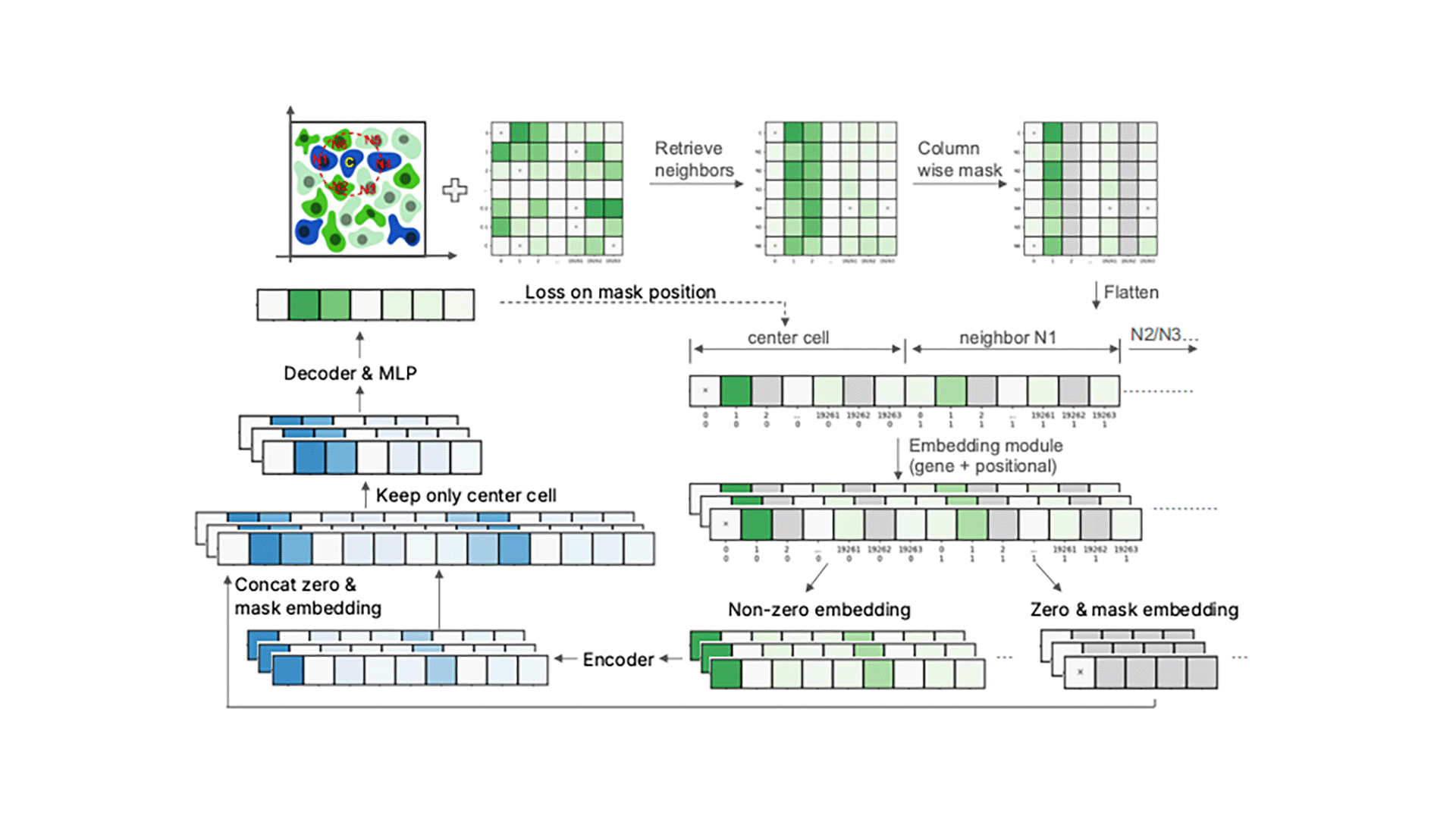
Asymmetric Encoder-Decoder
To efficiently model multi-cell neighborhoods, AIDO.Tissue employs an asymmetric encoder–decoder design:
- Encoder — jointly processes the gene expression of all cells in the neighborhood, capturing cross-cell dependencies using a novel 2D positional encoding scheme that reflects spatial organization.
- Decoder — reconstructs only the gene expression of the center cell, concentrating learning on the biologically relevant target.
This asymmetric structure dramatically reduces computational cost while preserving the ability to learn rich spatial representations. It enables scaling to large datasets and larger neighborhood sizes without an explosion in memory or compute requirements.

Figure 2. Asymmetric encoder-decoder architecture of AIDO.Tissue FM.
Downstream Tasks That Benefit from Neighborhood Context
AIDO.Tissue was evaluated on tasks where spatial structure is intrinsically important:
- Spatial Cell Type Classification — identifying cell types using both gene expression and neighborhood context.
- Cell Niche Prediction — predicting the functional microenvironment a cell occupies, which inherently depends on surrounding cells.
- Cell Density Estimation — estimating how many neighboring cells surround a given cell, reflecting tissue organization.
Across these tasks, models that leveraged neighborhood information consistently outperformed those that ignored spatial context and other competing models, including CellPLM and NicheFormer, demonstrating that spatial relationships are not merely auxiliary information — they are biologically predictive signals.

Figure 3. AIDO.Tissue achieves SOTA performance in cellular predictions requiring spatial context.
How Performance Scales with Neighborhood Size
AIDO.Tissue’s advantage is not limited to architectural novelty. The framework was explicitly evaluated to understand how performance scales as the number of neighbors (k) increases.
We systematically evaluated fine-tuned cell niche prediction models across multiple neighborhood sizes — including 8, 32, and 64 neighboring cells.
The key finding is clear:
Models that incorporate more neighboring cells consistently achieve stronger performance on spatial transcriptomics tasks — even when the total number of model parameters remains constant.
This result shows that performance gains are driven by spatial information, not merely by increasing model size.
As neighborhood size grows, the model captures richer representations of local tissue architecture. In other words, when AI systems better understand how cells relate in space, they learn deeper biological structure.


Figure 4. AIDO.Tissue’s performance on cell niche prediction improves as the cellular context (the number of neighbors) increases.
What This Means for Biology and AI
AIDO.Tissue represents an important step toward spatially aware foundation models that can be pretrained on large-scale spatial transcriptomic datasets and fine-tuned for diverse biological applications.
By moving beyond isolated cell inputs and embracing spatial neighborhoods, this framework:
- Learns biologically meaningful representations that reflect tissue architecture
- Outperforms non-spatial approaches while using less parameters
- Scales and improves as more neighboring cells are incorporated
- Provides a computationally efficient architecture toward tissue-level foundation models
In Closing, AIDO.Tissue reinforces a broader lesson for AI in biology: context matters. Tissues are structured systems of interacting cells. Models that explicitly incorporate spatial relationships unlock deeper insight, stronger predictive power, and more faithful representations of biological reality. As spatial transcriptomics continues to expand in scale and resolution, spatially informed foundation models like AIDO.Tissue may become essential infrastructure for the next generation of computational biology.