Biology is fundamentally multiscale, spanning from subcellular machinery to complex organ systems. Because disease often disrupts this entire hierarchy, true understanding of disease requires integrating diverse data scales rather than analyzing them in isolation. At GenBio AI, we develop world models for biology to decode and simulate biology across scales.
At the tissue level, H&E whole-slide images (WSIs) capture physical architecture, while spatial transcriptomics maps the underlying molecular state. To bridge these modalities and provide the infrastructure for multiscale discovery, we introduce GenBio-PathFM, a 1.1B-parameter foundation model for histopathology.
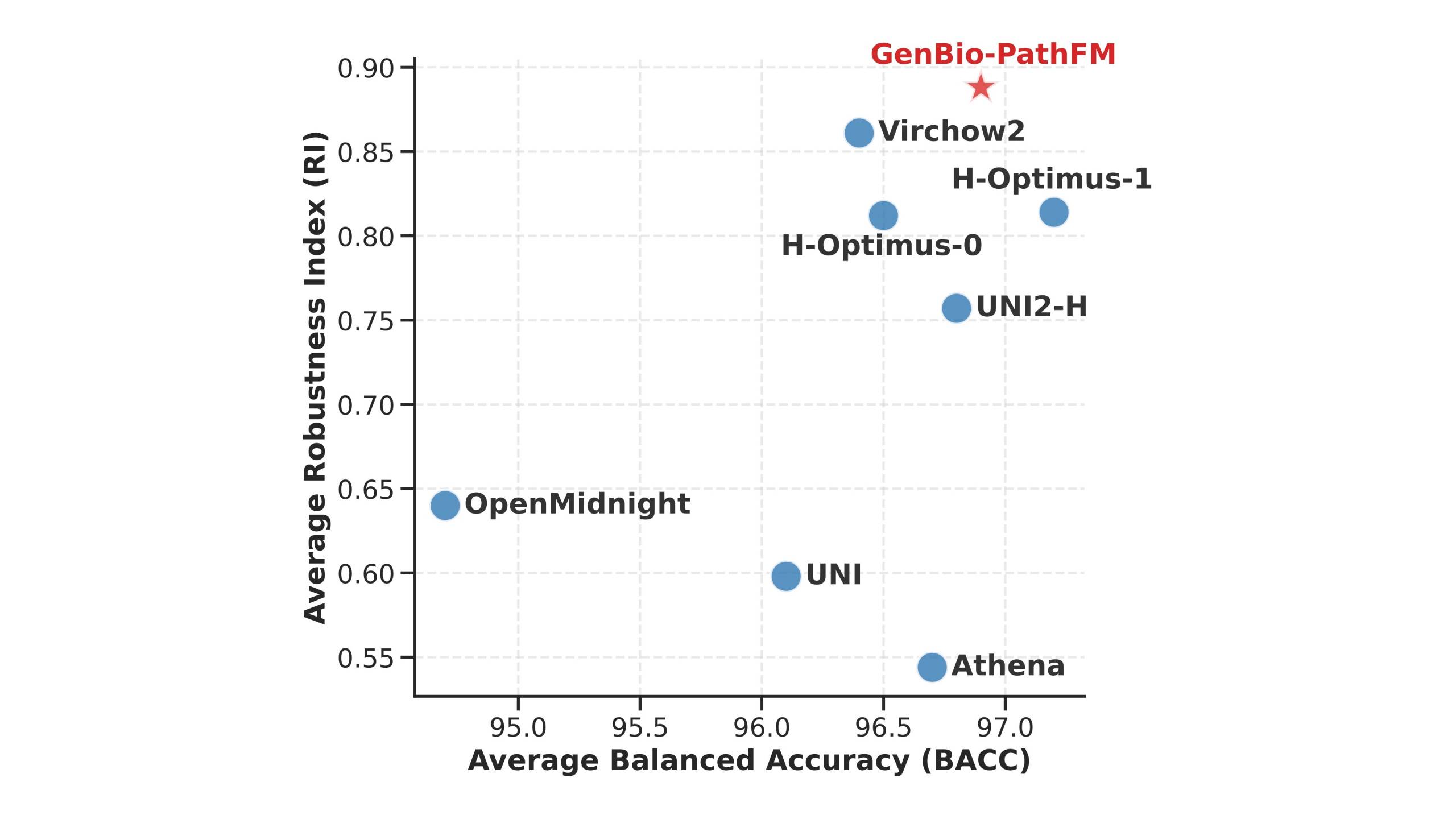
GenBio-PathFM achieves state-of-the-art (SOTA) results on public computational pathology benchmarks like THUNDER, HEST, and PathoROB (Figure 1) while using only 10-20% of the data required by current leading models. Furthermore, GenBio-PathFM is the strongest open-weight model released to date and the only SOTA model trained exclusively on public data. See our paper for full details.
GenBio-PathFM complements AIDO.Tissue FM, GenBio AI’s open-weight foundation model for spatial transcriptomics. See the AIDO.Tissue FM paper and blog post (coming soon!) for further details.

Automated Data Curation for Smarter Scaling
As digital pathology matures, the volume of whole-slide image (WSI) collections is expanding rapidly. The standard response has been to scale up training datasets, which often reach millions of slides. However, this brute-force approach ignores the fact that histopathology data is long-tailed. A small number of common morphologies dominate, while the most diagnostically significant features (e.g. rare variants, transition regions, disease markers) appear infrequently (Figure 2). Simply increasing the dataset size leads to inefficient training on massive amounts of redundant data.
To break this trend, we developed a data curation pipeline that shifts the focus from slide-level scaling to intelligent tile-level selection. Our method identifies and prioritizes informative, high-entropy content across 177k public WSIs. This “quality over quantity” approach ensures the model spends its compute budget on a diverse and compact training set rather than seeing the same common patterns repeatedly.
By focusing on morphological diversity and using a novel pretraining recipe, GenBio-PathFM matches or outperforms models trained on much larger collections of whole-slide images (Figure 4). This represents a 5x-15x improvement in data efficiency. These findings imply that the field may be entering a phase of diminishing returns for “brute-force” scaling, where the training procedure (described below) and the quality of training signals, rather than sheer specimen count, become the primary drivers of model utility.


Figure 2. Comparison of tile sampling strategies. The left panel shows randomly sampled tiles, which are highly redundant and capture similar morphological patterns. The right panel shows tiles selected by our curation method, exhibiting greater morphological diversity.
Scalable and Efficient Self-Supervised Learning
The performance of GenBio-PathFM is underpinned by a robust technical foundation that bridges advanced algorithmic design with high-performance computing. Our approach utilizes a dual-stage learning strategy called JEDI (JEPA + DINO) that transitions from capturing broad tissue structures to resolving fine-grained biological signals.

Stage 1: Discriminative Pretraining. We begin with a highly scalable self-supervised learning (SSL) framework based on the DINO family of algorithms. This stage focuses on learning strong discriminative representations of coarse tissue morphology. To ensure stability at a 1.1B-parameter scale, we modernized the optimization pipeline with a Warmup-Stable-Decay (WSD) scheduler. This allows the model to safely reach high learning rates and sustain stable optimization before decaying for convergence, mitigating the instabilities common in large-scale SSL. This is followed by Multi-Scale Post-Training, a brief continued pretraining phase in which we expose the model to varying tile sizes (224 to 288 pixels) to learn scale-robust representations.
Stage 2: Teacher-Guided Refinement. Building on recent advances in compute-efficient learning, we added a JEPA-based post-training stage. In this phase, the Stage 1 encoder is frozen and used as a “teacher” to guide a student network through specialized masking objectives:
- Masked Region Prediction: The student infers missing structures in patches masked out of a tile, encouraging a deeper understanding of fine-grained tissue architecture.
- Visible Region Prediction: The student matches teacher representations on unmasked areas, stabilizing the learning process.
- Outpainting: The student predicts representations for regions outside the visible crop, promoting long-range spatial reasoning.
This second stage is exceptionally efficient. Because it requires only a single view per image, coupled with a 50% masking ratio and a short training duration, it achieves 10x lower memory usage and FLOPs than Stage 1.
Other key technical elements include:
- Warmup-Stable-Decay (WSD) Scheduler: This allows the model to safely reach high learning rates, maintain stability, and then decay for convergence.
- Streaming Data Infrastructure: We use the WebDataset format for sharded, streaming access to increase throughput during training and inference.
The final result is a training pipeline that maximizes hardware utilization and learning efficiency, turning raw pathology images into a powerful foundation model in a fraction of the traditional training time.
State-of-the-Art Performance and Robustness
The true value of a foundation model lies in its ability to generalize across diverse clinical and biological tasks without succumbing to technical noise. GenBio-PathFM achieves top-tier performance across all major pathology benchmarks, demonstrating not only high average scores but also remarkable consistency and stability across tasks. In contrast to other models that excel in a subset of datasets while underperforming in others, GenBio-PathFM is consistently among the top performers across all benchmarks.
This balanced performance is highlighted in Figure 1 and Figure 4, which summarize results across three benchmarks: THUNDER, HEST, and PathoROB.
THUNDER evaluates clinical subtyping and grading across multiple cancer types and magnifications. GenBio-PathFM achieves the highest overall average (81.8), outperforming competitors like UNI2-H and H-Optimus-1. It maintains top-tier results across challenging datasets like BRACS and CCRCC, showing robust generalization across cancer types.
HEST measures gene expression prediction from histology, testing the model’s ability to perform complex morphology-expression mapping. GenBio-PathFM achieves the best performance on 5 of the 9 datasets in the HEST framework – the highest among all open-weight models – outperforming models trained on significantly larger, privately curated datasets. HEST tasks are normally solved separately, but we show that GenBio-PathFM can be used to solve them all simultaneously, with a performance boost of 59%.
PathoROB is a recent benchmark which assesses robustness to technical and institutional variation across multi-center datasets. As models move toward clinical deployment, they must resist “shortcuts” like making predictions based on staining protocols or scanner types. GenBio-PathFM exhibits a substantially higher Robustness Index than competing models while maintaining near-state-of-the-art task performance.

Conclusion
GenBio-PathFM demonstrates that high-performance computational pathology can be achieved with extraordinary improvements in data efficiency. By leveraging high-entropy, tile-level curation and our novel pretraining method (JEDI), we have proven that better methodology augments data scaling. Viewed another way, our results suggest that future data acquisition should prioritize “high-entropy” content (e.g. rare histological variants, multi-center staining protocols, and complex tissue architectures) rather than the unconstrained aggregation of redundant slides.
For full details, please see the paper.
GenBio-PathFM is available on GitHub under the GenBio AI Community License.
All data used to train and evaluate GenBio-PathFM is available from the original data sources under their respective license terms.