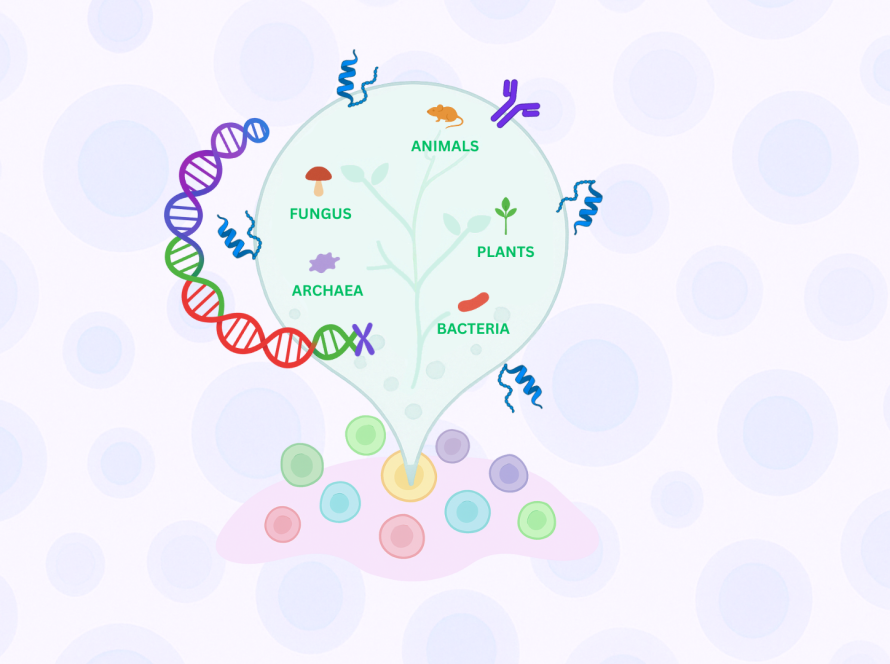
What if we could build a virtual version of a living cell—one that lets us simulate what happens when a gene is turned off, a drug is introduced, or a biological pathway is altered? This is the long-term vision behind a virtual cell: a world model of biology that can predict, simulate, and even program cellular processes across scales. Such a system would allow scientists to explore and test ideas computationally before performing experiments in the lab.
In this blog, we show that an AI system developed at GenBio AI can dramatically accelerate this process. Our system, VCHarness, autonomously proposes models, writes code, runs experiments, learns from results, and iterates. Across multiple CRISPR gene knockdown benchmarks, it discovers models that outperform expert-designed baselines while reducing development time from months to days. We focus on predicting gene expression changes following CRISPR perturbations as a representative use case, but the system is broadly applicable to other virtual cell and biomedical tasks. For more technical details, see our paper Harnessing AI to Build Virtual Cells.
The Problem: Building Cell Models Is Still Slow and Manual
Today, even building one good model for this kind of task can take a long time. Researchers often need to design the model by hand, tune many settings, fix training problems, and test lots of ideas one by one. Small design choices can have a big effect, so progress often depends on repeated trial and error.
Our idea is simple: instead of having humans do all of this manually, let AI handle more of the model-building process. Recent biological foundation models already capture useful information about DNA, proteins, RNA, and cells. AI coding agents can write and debug code. Search methods can help decide which ideas are worth testing next. Put together, these pieces make it possible to automate much more of the workflow.
The Idea: Let AI Build the Models

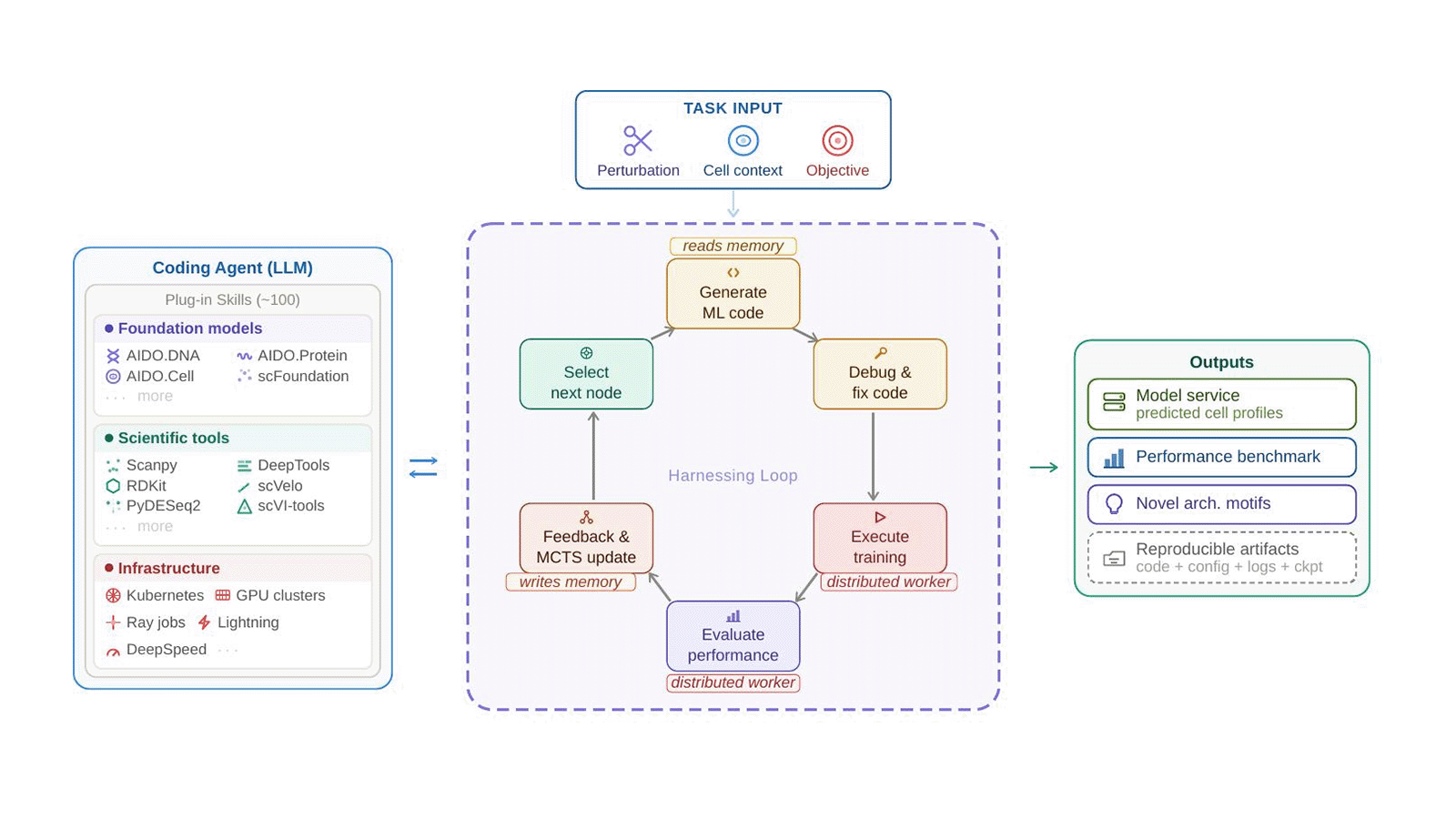
VCHarness is designed as a closed-loop system which iterates over the following steps:
- Biological Foundation Model Library VCHarness starts with a library of pretrained biology models. These models already contain useful knowledge about DNA, proteins, and cells, so the system does not have to start from zero every time.
- AI Coding Agent The coding agent writes model code, fixes bugs, launches training jobs, and reads the results. It acts a bit like an automated research assistant that can keep iterating.
- Monte Carlo Tree Search (MCTS) This search method helps the system decide what to try next. Instead of guessing randomly, it balances two needs: exploring new ideas and spending more time on ideas that already look promising. MCTS chooses where to look, and the coding agent decides what model to build there.
- Feedback Memory After each run, VCHarness saves what happened: which ideas worked, which failed, how good the scores were, and what problems came up. That way, later attempts can learn from earlier ones.
- Distributed Execution Model training is the most time-consuming step, so VCHarness distributes the work across multiple machines in a sandboxed environment. This allows it to evaluate more experiments faster.
The full loop is straightforward: generate a model → fix issues if needed → train it → measure its performance → learn from the result → choose the next idea. Then the cycle repeats.
Key Result #1: It Beats Human-Designed Models

We tested VCHarness on a benchmark of CRISPR gene knockdown datasets . The task is to predict how a cell’s gene-expression pattern changes after a specific gene is turned off. We evaluated the system on four human cell lines: K-562, HepG2, Jurkat, and hTERT-RPE1.
We compared it with a broad set of existing approaches, including models based on expression data, proteins, DNA, and prior biological knowledge. This matters because it shows the system is not beating just one narrow baseline. It performs well against many different types of expert-built methods.
Key Result #2: It Finds Good Models Early
One striking pattern is that VCHarness often finds strong ideas early in the search, then spends more time refining them. In other words, it does not need to test every possible model before becoming useful.
The videos below show how the search unfolds for each cell line. You can think of them as a visual map of the system trying many paths, spotting promising ones, and then focusing more effort there.
If you want to interactively explore the Monte Carlo search trees for all four cell lines, please visit VCHarness Task Navigator.
Search trace showing how promising model ideas emerge over time
Search trace showing how promising model ideas emerge over time
Search trace showing how promising model ideas emerge over time
Search trace showing how promising model ideas emerge over time
Key Result #3: It Discovers New Model Designs
The most interesting part may be that VCHarness does not only tune known model types. It can also discover new combinations of parts that human researchers might not think to try first. Some winning designs mix graph information, cell models, protein models, and selective fine-tuning in unusual ways.
The exact model differs from one cell line to another, but the broader pattern stays the same: VCHarness keeps finding useful designs that combine information in smart ways. That is why we see it as more than a single good model. It is a system for discovering good models.
The Bigger Vision: Toward a More General Virtual Cell
CRISPR knockdown prediction is only one starting point. The larger goal is to build systems that can model more parts of cell biology, across more types of data and more kinds of questions. VCHarness is designed as a general framework, so the same loop can be reused in many settings.
For example, the same idea could be used for DNA-based tasks, protein-related tasks, or other ways of predicting how biological systems respond to change. The details of the task would change, but the overall process would stay similar.
Over time, this could move us closer to a richer virtual cell: one that helps simulate biological systems, predict outcomes across different scales, and guide experiments or therapies more effectively.
The important point is that what carries over is not one fixed model architecture. What carries over is the closed-loop search process: propose, test, learn, and improve.
From Months of Manual Work to Days of Search
One practical benefit is speed. Instead of taking months of expert trial and error, VCHarness can run day-scale autonomous search campaigns. That does not remove the need for scientists, but it can greatly reduce the amount of repetitive model-building work they need to do by hand.
Why This Matters
This work suggests a broader shift in how AI may support biology. Instead of only helping scientists analyze data, AI can also start to help design the models used to understand that data.
Of course, this is still an early step. A true virtual cell remains a long-term goal, and there is a lot more to build. But these results show that autonomous model construction is already becoming useful in real biological problems.
In that sense, the key change is not only better benchmark scores. It is the move from humans building every model by hand toward AI systems that can help build, test, and improve models on their own.
Conclusion
VCHarness is an early example of AI not just using biological models, but helping create them. By integrating foundation models, an AI coding agent, and a smart search strategy into one system, it can discover strong model designs for perturbation-response prediction.
We see this as one step toward a future where AI helps build the pieces of a virtual cell more quickly and more systematically. If that trend continues, it could change how we study disease, design experiments, and develop new therapies.
Interested in the future of AI-driven biology? Careers · X · YouTube · LinkedIn