TL;DR
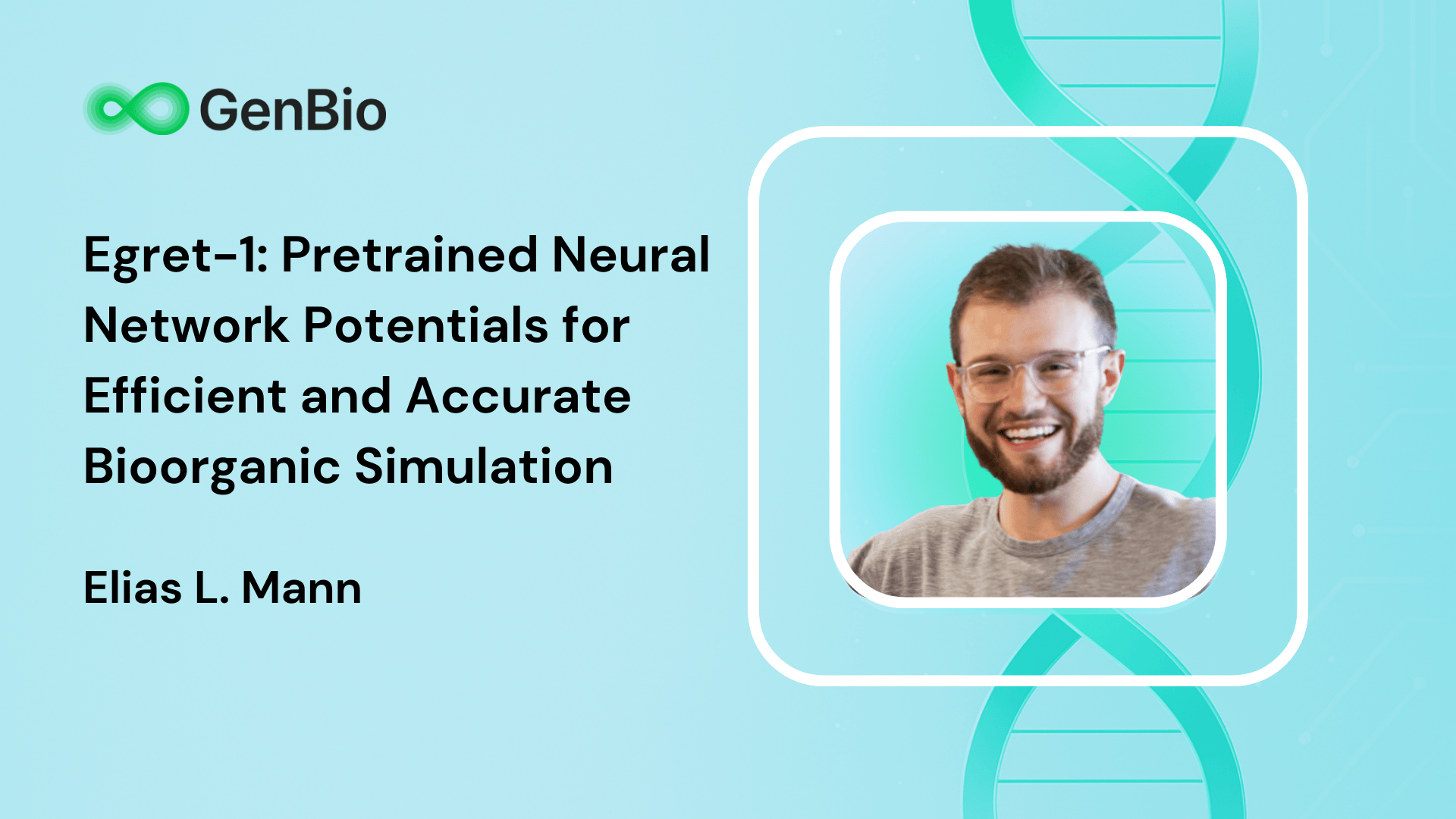
In this talk, Eli presents “Egret-1: Pretrained Neural Network Potentials for Efficient and Accurate Bio-Organic Simulation” at the Foundation Models for Biology Seminar Series by GenBio AI. He introduces Egret-1, a family of large pretrained neural network potentials (NNPs) based on the MACE architecture, designed for main-group, organic, and biomolecular chemistry. Egret-1 addresses the long-standing tradeoff between speed and accuracy in molecular simulation by delivering density-functional-theory (DFT) level accuracy on tasks such as torsional scans, conformer ranking, and geometry optimization, while achieving major speed improvements over traditional methods. By narrowing the gap between efficiency and precision, Egret-1 makes quantum-informed simulation more practical and scalable for real-world chemistry and biology.
Introduction
Imagine running a drug discovery project and waiting days for a DFT calculation to finish, only to realize the pace of your research has already moved on. Now imagine getting nearly the same level of accuracy in a fraction of the time.
This is the trade-off researchers face every day: density-functional theory (DFT) offers gold-standard accuracy but is painfully slow, while classical force fields are fast but often lack the precision needed for high-stakes bio-organic tasks. Most existing neural network potentials (NNPs) are built for crystalline solids, leaving a gap for the small molecules and biomolecules at the center of drug design and biological chemistry
Egret-1 fills this gap, built on the MACE architecture and trained on high-level quantum data, it brings DFT-like accuracy to everyday molecular tasks such as geometry optimization, torsion analysis, reactions, and molecular dynamics (MD) at speeds far closer to practical, day-to-day use than DFT.
Full Talk
Watch the full talk below:
The Problem
- Accuracy vs speed: DFT is precise, force fields are fast.
- Domain gap: many public NNPs focus on crystalline solids.
- Practicality: few open models validated on bio-organic tasks.
Egret-1 addresses these gaps directly, providing a molecule-first NNP that combines speed, accuracy, and accessibility for real-world chemistry.
What Is Egret-1?
Egret-1 is a family of pretrained NNPs designed for organic and bio-organic systems. Built on the MACE message-passing architecture, it predicts total energies, and forces are obtained conservatively as energy gradients. The models accept global charge as input, are trained on carefully curated, high-level quantum data, and target DFT-like accuracy at much lower cost.
Key features:
- Targeted domain: optimized for organic and bio-organic molecules.
- Physics-aware design: atoms as nodes, bonds and contacts as edges.
- Rotational equivariance (SO(3)) and high-body-order terms.
Model Variants
- General model: (Egret-1) balanced accuracy across diverse tasks.
- Energy model (Egret-1e): tuned for precise single-point energies.
- Reaction model (Egret-1t): improved barrier heights and reaction profiles.
How It’s Trained
Egret-1 is trained on curated, high-level quantum data covering diverse organic and bio-organic molecules. The MACE backbone captures angular information and higher-order interactions. The models predict energies, and forces are computed as the gradients of energy with respect to atomic positions, which improves smoothness and MD stability.
Benchmarks That Matter
Eli reports evaluations on geometry, torsions, reaction barriers, and molecular dynamics, including suites such as GMTKN55 and ROT34. On the tasks shown, Egret-1 approaches DFT accuracy and outperforms prior NNPs and semi-empirical baselines in several settings.
A highlight from the talk: the general model can optimize small bio-organic systems quickly on a single H100, making higher-accuracy workflows more practical. (See the talk for exact setups and hardware.)
Future Directions
- Looking ahead, Egret-1’s development highlights broader priorities for advancing neural network potentials: smarter data design, incorporation of explicit long-range physics, scalable models that extend to proteins and periodic systems, transfer learning approaches for site-specific reactivity, and transformer-style architectures that integrate attention while preserving molecular symmetry.
Final Thoughts
Egret-1 combines careful architecture and curated training data to make neural potentials practical everyday tools. By pairing quantum-level accuracy with far lower compute cost, it turns advanced molecular simulation into a routine step in experimental planning. This shift accelerates discovery in chemistry and biology, making high-precision modeling accessible for researchers tackling complex bio-organic challenges.
The full paper for Egret-1 can be found on arXiv.
Join us in our mission to push the frontiers of AI-driven biology and strive to make a lasting impact on medicine, biotechnology, and human health. We are hiring across teams. Visit our Careers page to learn more and apply. Follow us on X, YouTube, and LinkedIn.