TL;DR
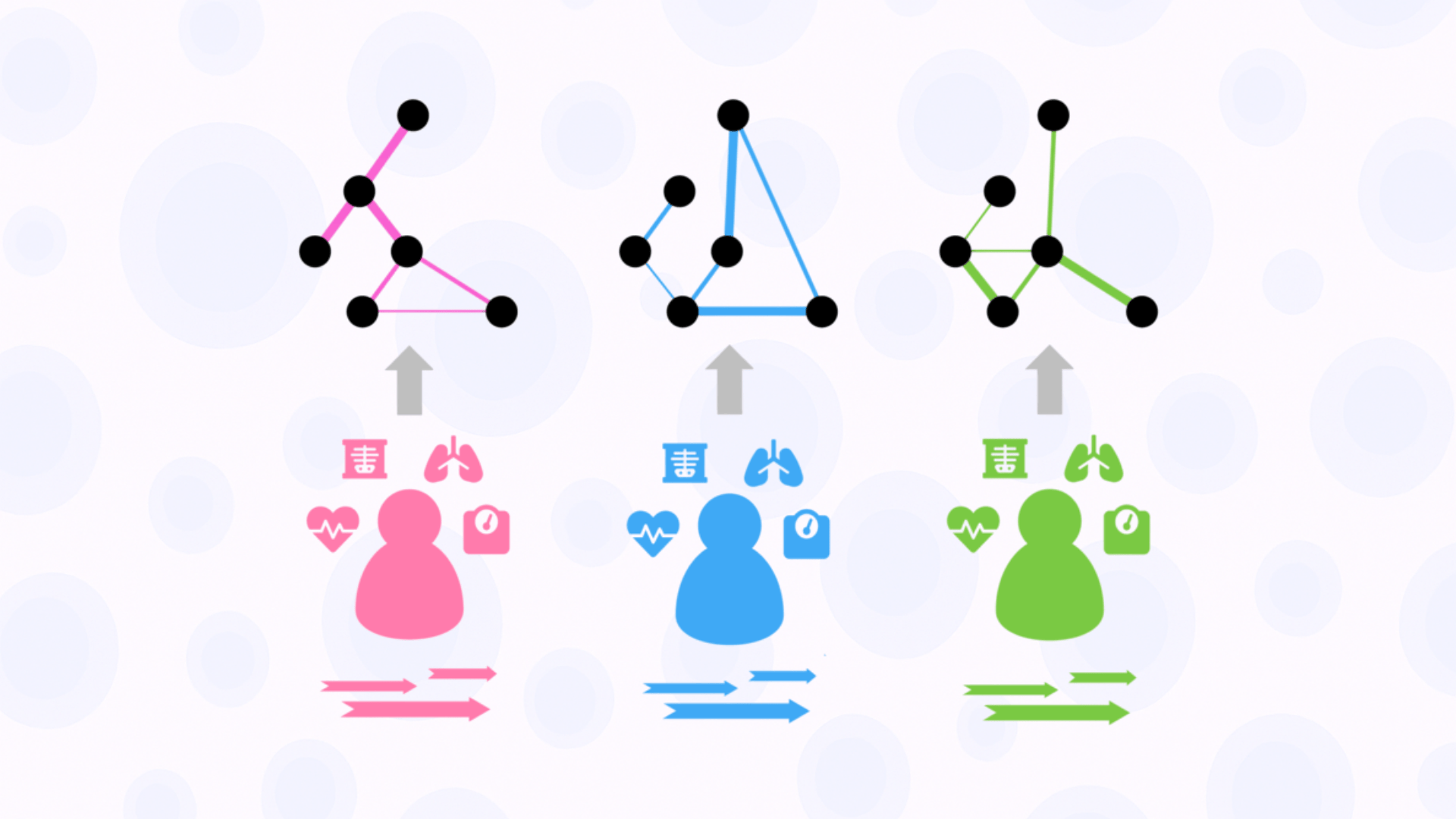
Contextualized modeling, a new family of machine learning algorithms developed at CMU by GenBio AI scientists Caleb Ellington and Eric P. Xing, is laying the foundation for AIDO’s long-term vision of personalized, multiscale biological simulation. In the recent PNAS study “Learning to estimate sample-specific transcriptional networks for 7,000 tumors” Ellington and Xing showed that this method can compile thousands of clinical, genomic, and molecular contexts into personalized models of the biological programs underlying cancer progression and treatment. Now, these methods are being used to design and personalize much more powerful simulation programs in AIDO, using context-aware modeling to capture hidden biological heterogeneity and provide insights for patients with rare or completely unknown diseases. Now, GenBio AI is poised to leverage the knowledge and tools that Xing has been cultivating for over a decade to enable personalized, multimodal, and multi-scale models of biology.
Introduction
Cancer is an intimidating adversary, its complexity often as unique as the individuals it affects. For decades, researchers have aimed to solve its complicated mechanisms, striving for breakthroughs that lead to more effective treatments. But what if we could move beyond a one-size-fits-all approach and truly understand each tumor’s unique pathology? This is the promise of personalized medicine, and it requires a new generation of modeling.
At GenBio AI, we’re building the AI-Driven Digital Organism (AIDO), a revolutionary system for biological simulation across contexts and scales. Our ambition is to predict, simulate, and ultimately program biology at all levels, from molecular interactions within a single cell to complex disease dynamics across patient populations. Such a tool would revolutionize cancer care, giving biologists and clinicians the tools to simulate disease progression and potential treatments for each and every patient. To achieve this, AIDO must address two fundamental challenges in both biology and machine learning, which have been the subject of decades of research: (1) AIDO must generalize effectively to new and unseen contexts, accurately simulating novel treatments or emerging disease variants, and (2) AIDO must seamlessly combine multiple models across diverse biological scales and data modalities to simulate biological systems holistically.
A recent breakthrough developed at Carnegie Mellon University offers a promising solution. In this study, led by GenBio AI Research Scientist Caleb Ellington and GenBio AI Co-Founder and Chief Scientist Eric Xing, published in PNAS as “Learning to estimate sample-specific transcriptional networks for 7,000 tumors,” we introduce Contextualized Models, a new approach that enables personalized, sample-specific insights. This work lays important groundwork for AIDO and strengthens our vision for a system of multiscale foundation models.
In this blog post, we’ll dive into how Contextualized Models are changing the game. You’ll see how they learn across diverse cancer types, predict disease outcomes, and reveal hidden drivers of tumor behavior, providing a fundamental blueprint for AIDO’s capabilities. Get ready to explore a future where cancer research is smarter, more adaptable, and ultimately, more hopeful.
Methodology
To truly personalize care for cancer patients, a core goal for AIDO’s biological simulations, we need to understand the intricate molecular workings within each individual’s disease. This is precisely where Gene Regulatory Networks (GRNs) become crucial. These “maps” detailing how genes influence each other’s activity are essential for revealing the fundamental mechanisms driving cancer progression and response to treatment.
However, traditional methods for inferring these vital GRNs fall short. They typically require massive amounts of data, often forcing researchers to group samples (e.g., by cancer type or cell line) and then create a single, averaged GRN for that entire group. This “cluster-level” approach critically overlooks the inherent biological heterogeneity within these groups. It misses the individual ways genes interact in each distinct patient or tumor, which are the variations vital for understanding disease progression, predicting treatment response, and ultimately, for AIDO to build comprehensive, patient-specific simulations.
To address this fundamental limitation of traditional GRNs and unlock personalized insights, Caleb and Eric developed a new approach: Contextualized Learning. This isn’t just another algorithm for addressing a single problem; it’s a type of multitask learning designed to tackle a series of related problems simultaneously, improving every task in the process. Instead of building one GRN for all, the model learns to infer a unique GRN for each individual sample, treating every patient’s molecular profile as a distinct but related “task.” This innovative design allows the model to use shared information across patients while still capturing the unique nuances specific to each one, leading to far more accurate and relevant insights. This approach is foundational to the personalized and multiscale modeling efforts central to AIDO.
This individualization is achieved through the concept of “contexts,” which help the model understand the similarities and differences between each unique modeling “task.” In this case, each patient. A context is a rich tapestry of unique information woven around each biological sample. The paper terms this “multiview contexts,” emphasizing that this data comes from diverse sources spanning different data types. This includes valuable clinical information (tumor stage, grade, demographics, and treatment journey), intricate molecular information (genetic mutations, gene copy number variations), and environmental information, both micro (immune cell activation) and macro (tumor localization). For every tumor sample, all this unique data is distilled into a comprehensive “context vector,” which holds a digital summary of its singular characteristics.
This meticulously crafted context vector then becomes the key to unlocking truly personalized GRNs. The contextualized learning framework uses it to dynamically generate an individualized GRN model for each and every sample. This means the very parameters of the GRN model, which define how genes interact, become a direct function of that sample’s unique context. Imagine: the model learns how a particular mutation, a specific clinical feature, or even a unique epigenetic mark might subtly (or dramatically) alter the intricate dance of gene relationships within that individual’s tumor, moving beyond a static, generic map.
After being trained on a diverse collection of patient samples, their unique contexts, and corresponding expression data, the model gains the profound capability to predict a plausible, sample-specific GRN for a brand-new patient sample it has never encountered. All it requires is the new patient’s context vector. This generalization is vital for translating research into clinical practice, ensuring these powerful, personalized models can directly inform future treatment decisions. This capability is a cornerstone of AIDO’s predictive power, enabling the platform to offer actionable insights on novel biological states and patient profiles without requiring extensive retraining.

Impact on AIDO
While the study “Learning to estimate sample-specific transcriptional networks for 7,000 tumors” focuses on small-scale statistical models, its principles carry direct and profound consequences for building large-scale, AI-driven simulators like AIDO. A key feature of contextualized modeling is that most models can be contextualized, whether they are simple statistical models or large-scale neural networks. This means that while the study uses hand-crafted genomic features as context and small-scale GRNs to represent cellular systems, these components can be easily swapped out for state-of-the-art foundation models, leveraging the powerful representations from massive pretraining while also merging multiple foundation models into a single context-adaptive and multiscale model. This procedure can be directly repeated and scaled to incorporate new modalities and new component models, providing AIDO with a unified framework for building multiscale simulators that can ingest data from diverse contexts, capable of capturing the complexity and heterogeneity of real biology. It ensures that AIDO’s foundation models can continuously adapt and refine their understanding of biological systems as new contextual information becomes available.
Crucially, this research demonstrates how these principles translate into tangible benefits for AIDO. For instance, the significant increase in model accuracy achieved by adding context highlights the profound biological heterogeneity previously uncaptured by traditional models, highlighting the critical need for personalized approaches in understanding disease. Furthermore, the study demonstrates how generalization to completely unseen diseases and contexts can be achieved, a core capability for AIDO’s ability to offer actionable insights on novel biological states without extensive retraining. Ultimately, the contextualization framework proves to be a natural and powerful way to integrate multi-modal information from different scales, which is essential for AIDO to capture the holistic complexity of real biology.
Indeed, this research exemplifies GenBio AI’s commitment to building models that support personalized treatment strategies. The concept of context-adaptive models for dynamic biological systems and multiscale information integration directly underpins AIDO. We are building a system of multiscale foundation models designed to predict, simulate, and program biology at all levels. Contextualization provides a tool uniquely suited for AIDO to capture how molecular features interact within and across biological scales, providing a dynamic and personalized understanding of disease mechanisms. By demonstrating the power of contextualized models to infer individualized biological networks, this early work provided a vital blueprint for how GenBio AI approaches the intricate challenge of modeling complex biological systems. This reinforces our expertise in developing sophisticated AI solutions that can translate complex biological data into actionable insights, paving the way for truly personalized medicine.
Tools and Resources
To support the broader research community, Ellington, Xing, and collaborators have released a Python package, Contextualized, for training and analyzing contextualized models. Additionally, an interactive visualization toolkit is available on GitHub, enabling exploration of inferred GRNs across various tumor types.
Final Thoughts
The development of contextualized gene regulatory networks, as detailed in the study “Learning to estimate sample-specific transcriptional networks for 7,000 tumors,” marks an important step toward computational systems that are capable of personalized and multimodal simulation, supporting AIDO’s vision of modeling biological complexity across scales. By capturing the unique regulatory landscapes of individual tumors as they respond to each patient’s genetic, molecular, and clinical context, we are moving closer to enabling precise, data-driven insights into human biology and disease. As we continue to refine these models and integrate them into AIDO, we anticipate further advancements in precision medicine.
Join us in our mission to push the frontiers of AI-driven biology and strive to make a lasting impact on medicine, biotechnology, and human health. We are hiring across teams. Visit our Careers page to explore open roles and apply. Follow us on X, YouTube, and LinkedIn.