TL;DR
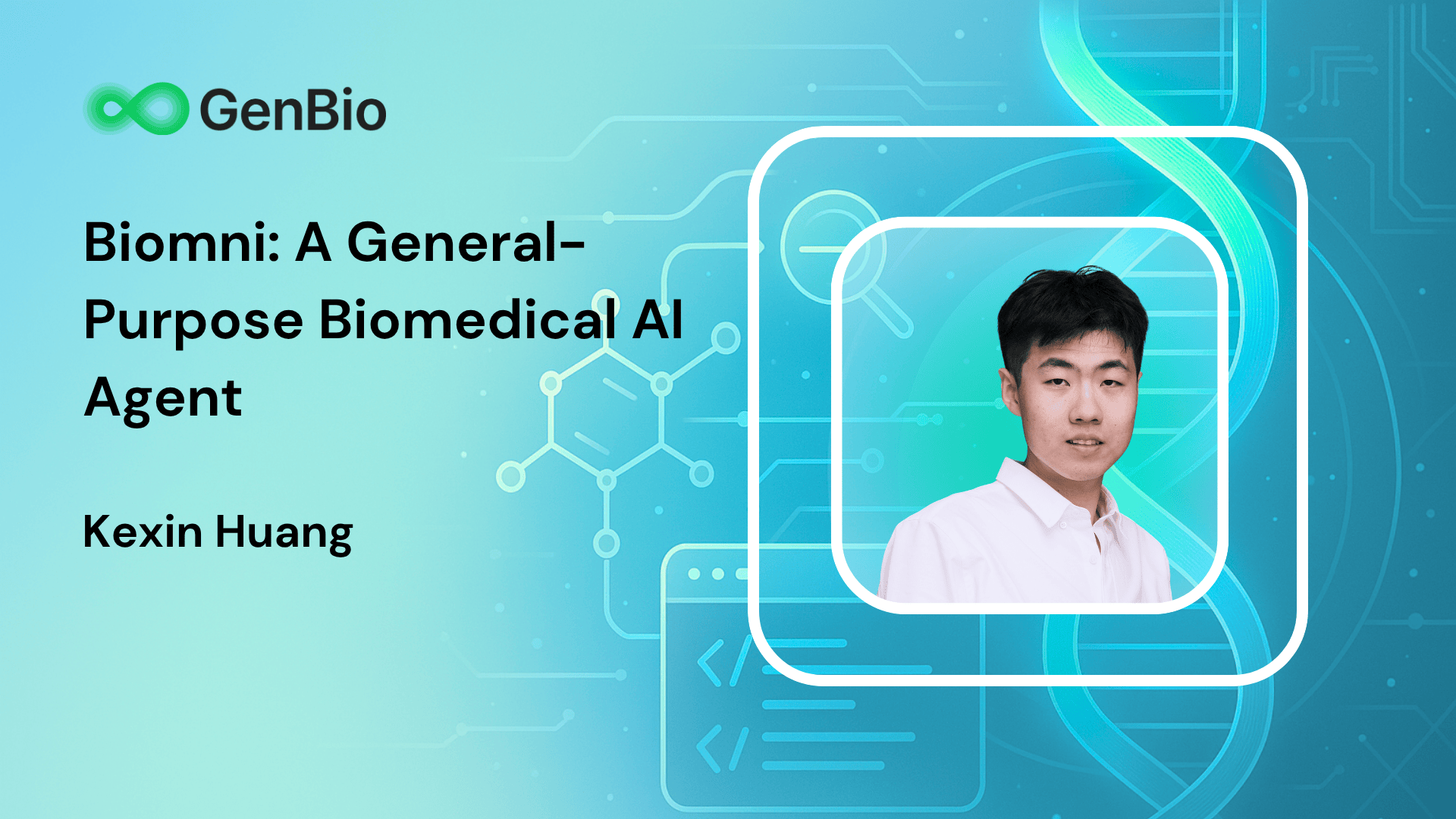
In this talk, Kexin Huang presents his paper “Biomni: A General-Purpose Biomedical AI Agent” at the Foundation Models for Biology Seminar Series by GenBio AI. He introduces Biomni, a biomedical AI agent designed to autonomously execute research tasks across domains by integrating large language model reasoning, retrieval-augmented planning, and code-based execution. Biomni enables scientists to run workflows such as gene prioritization, drug repurposing, rare disease diagnosis, and microbiome analysis without relying on predefined templates, offering a more flexible and scalable approach to biomedical research.
Introduction
Biomedical research is evolving rapidly. The field now generates vast quantities of complex data, spanning genomics, proteomics, literature, and experimental protocols. Researchers rely on diverse tools, databases, and programming environments, yet the workflows remain fragmented and often repetitive. How can AI help scientists move faster, ask better questions, and design experiments more efficiently?
In the Foundation Models for Biology Seminar Series, Kexin introduced Biomni, a general-purpose AI agent built to execute biomedical tasks autonomously. Unlike task-specific pipelines, Biomni adapts dynamically to new domains and challenges. It is designed to serve as an intelligent assistant, an AI scientist that learns, plans, and acts across subfields.
Full Talk
Watch the full talk below:
The Problem: Fragmented Workflows in Modern Biomedicine
Biological research today spans dozens of subfields, each with its own tools, file formats, and experimental protocols. Researchers often need to combine literature reviews, data retrieval, hypothesis generation, statistical analysis, and code execution, repeatedly and manually.
Kexin described how these repetitive tasks, even at the PhD level, waste valuable time and create barriers to innovation. The fragmentation limits cross-domain exploration, slows down hypothesis testing, and places a high entry cost on new researchers entering the field.
What Is Biomni?
Biomni is a general-purpose biomedical AI agent. It’s not a chatbot, and it’s not a rigid pipeline. Instead, it combines three key capabilities:
- LLM-based reasoning for understanding biomedical questions and instructions
- Retrieval-augmented planning to select relevant tools, protocols, and datasets
- Code-based execution using an agentic framework to run commands, analyze data, and output results
The system begins by running an action discovery phase, mining tens of thousands of research papers to identify commonly used tools and workflows across 25 biomedical domains. These include genomics, drug discovery, rare disease diagnosis, molecular cloning, and more.
Once the environment is set, Biomni uses a generalist architecture to generate actionable plans and execute them without predefined templates.
Architecture Overview
The architecture consists of three main components:
- Planner
Takes natural language prompts (e.g., “Prioritize causal genes for this phenotype”) and plans out tasks using retrieval-augmented LLM reasoning. - Skill Retriever
Pulls relevant tools, functions, and resources using a dense retriever trained on biomedical software and literature. - Executor
Carries out the workflow step by step, using modular agents that can access APIs, write code, and analyze results, all within a safe, interpretable execution framework.
The design avoids hardcoding specific workflows, allowing Biomni to generalize to new tasks, tools, and modalities.
Benchmarking Across Biomedical Domains
Biomni was tested across a range of complex research tasks:
- Gene Prioritization
It identified candidate genes associated with phenotypes by mining disease databases, literature, and gene interaction networks. - Drug Repurposing
Given a disease condition, Biomni analyzed compound databases and literature to suggest potential treatments. - Rare Disease Diagnosis
The agent evaluated symptom descriptions and genetic variants to propose possible rare diseases. - Microbiome Analysis
Biomni automatically preprocessed microbial gene expression data, performed clustering, and interpreted microbial associations. - Molecular Cloning
The system designed cloning experiments by integrating protocols and reagent specifications from experimental databases.
In all cases, Biomni completed the tasks without manual prompt tuning, showing its generalization ability across modalities.
Real-World Case Studies
During the talk, Kexin presented several real-world applications:
- In one scenario, Biomni autonomously analyzed multi-modal datasets (genomics, clinical records, and pathway information) and generated an experimentally testable hypothesis.
- In another, the system synthesized a full experimental protocol including data acquisition, analysis, and result interpretation based on a short input prompt.
These examples suggest that AI agents like Biomni can function as junior research collaborators, accelerating discovery and enabling deeper exploration across disciplines.
Future Directions
Biomni is available for public use at biomni.stanford.edu, and the team invites researchers to test its limits, provide feedback, and propose new use cases.
Ongoing work will focus on:
- Expanding the tool and dataset library
- Improving reasoning under uncertainty
- Integrating wet lab and clinical data more deeply
- Enhancing explainability and user control
Final Thoughts
Biomni offers a new way to think about biomedical AI, not as a static model, but as an interactive agent that can reason, plan, and execute scientific workflows. As biomedical complexity grows, tools like Biomni could play a critical role in enabling faster, more flexible, and more reproducible research.
Explore the Biomni preprint on bioRxiv to learn more about the methodology and benchmarks.
Join us in our mission to push the frontiers of AI-driven biology and strive to make a lasting impact on medicine, biotechnology, and human health. We are hiring across teams. Visit our Careers page to learn more and apply. Follow us on X, YouTube, and LinkedIn.